

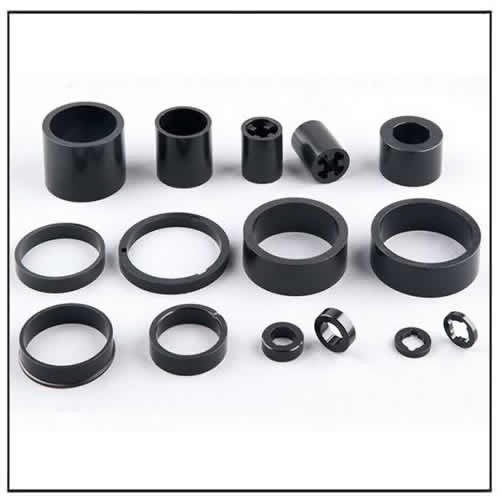

High Magnetic Strength: Bonded NdFeB magnets exhibit strong magnetic properties, including high remanence and coercivity. This makes them ideal for applications requiring a powerful and consistent magnetic field.
Complex Geometries: The bonding process allows for the production of magnets in complex shapes and sizes, which is often not feasible with sintered magnets. This flexibility in design facilitates the creation of intricate components tailored to specific application needs.
Corrosion Resistance: The polymer binder in magnets provides a level of protection against corrosion, enhancing the durability and lifespan of the magnets, especially in environments prone to moisture and other corrosive elements.
Cost-Effective Production: Compared to sintered NdFeB magnets, magnets are more cost-effective to produce, particularly for complex shapes and sizes. The manufacturing process involves less material waste and lower tooling costs.
Thermal Stability: While magnets do not match the high-temperature resistance of SmCo magnets, they still offer good thermal stability, making them suitable for applications with moderate temperature requirements.
FAQ
What are bonded magnets and how are they made?
Bonded magnets are composite magnets made by mixing magnetic powders with a polymer binder, which is then molded into various shapes. The process involves blending the magnetic material, such as Neodymium-Iron-Boron (NdFeB) or Samarium Cobalt (SmCo), with a plastic or rubber binder, followed by injection molding, compression bonding, or extrusion to form the desired magnet shape. This method allows for the creation of complex geometries that are not possible with traditional sintered magnets.
What are the key advantages of bonded magnets compared to sintered magnets?
Bonded magnets offer several advantages over sintered magnets:
Complex Geometries: The bonding process allows for the production of magnets in complex shapes and sizes, providing greater design flexibility for specific applications.
Cost-Effective Production: The manufacturing process is more cost-effective, particularly for intricate designs, as it involves less material waste and lower tooling costs.
Corrosion Resistance: The polymer binder provides inherent protection against corrosion, enhancing the durability of the magnets in harsh environments.
Isotropic Properties: Bonded magnets typically exhibit isotropic magnetic properties, meaning they can be magnetized in any direction, unlike sintered magnets which are anisotropic.
Reduced Weight: The addition of a polymer binder makes bonded magnets lighter, which is beneficial in applications where weight is a critical factor.
In which applications are bonded magnets commonly used?
Bonded magnets are used in a wide range of applications across various industries:
Automotive Industry: They are used in sensors, actuators, and motors, including those found in electric and hybrid vehicles, as well as in ABS braking systems.
Electronics: Commonly found in hard disk drives, mobile phones, and speakers, where reliable and strong magnetic fields are necessary.
Medical Devices: Used in equipment such as MRI machines, hearing aids, and other diagnostic tools due to their precise magnetic control and compact size.
Renewable Energy: Employed in wind turbines and other renewable energy systems to enhance efficiency and output.
Industrial Applications: Utilized in magnetic couplings, sensors, electric motors, and generators, providing robust and adaptable magnetic solutions.
What factors should be considered when selecting bonded magnets for an application?
When choosing bonded magnets, several factors need to be considered to ensure optimal performance:
Magnetic Strength: Assess the required magnetic properties, such as remanence and coercivity, to match the application's needs.
Temperature Limits: Bonded magnets have moderate thermal stability, so it's important to ensure the operating temperature does not exceed their limits, typically around 150°C (302°F).
Environmental Conditions: Consider the level of exposure to corrosive elements and whether additional coatings or treatments are necessary for enhanced durability.
Mechanical Stress: Evaluate the mechanical stress the magnets will be subjected to, as the polymer binder can make them more susceptible to damage compared to sintered magnets.
Magnetization Direction: Determine the required magnetization direction, keeping in mind that bonded magnets are usually isotropic and can be magnetized in any direction.
How do magnets compare to bonded SmCo magnets?
Bonded NdFeB and SmCo magnets each have their own set of advantages and are chosen based on specific application requirements:
Magnetic Strength: magnets typically offer higher magnetic strength compared to bonded SmCo magnets, making them suitable for applications requiring strong magnetic fields.
Temperature Resistance: Bonded SmCo magnets have better high-temperature resistance than bonded NdFeB magnets, maintaining their magnetic properties at temperatures up to 250°C (482°F) or higher, depending on the grade.
Corrosion Resistance: Both types have good corrosion resistance due to the polymer binder, but bonded SmCo magnets are inherently more resistant to oxidation and corrosion.
Cost: Bonded NdFeB magnets are generally more cost-effective than bonded SmCo magnets, especially for applications that do not require high-temperature stability.
Ultimately, the choice between bonded NdFeB and bonded SmCo magnets depends on the specific requirements of the application, including magnetic strength, temperature conditions, and cost considerations.
Hot Tags: bonded ndfeb magnet, China bonded ndfeb magnet manufacturers, suppliers, factory, lifting magnets 1000kg, diametrically magnetized cylinder neodymium magnet, 4 neodymium magnets, 10000 gauss neodymium magnets, giant neodymium magnet