

In the production system of modern magnetic materials, Ferrite magnets have played an important role in many fields due to their excellent electrical insulation, corrosion resistance and low-cost manufacturing process. Especially in household appliances, audio systems, automotive motors, industrial automation and medical equipment, we can see them. So, how is this familiar and critical magnetic material made? This article will take you to an in-depth understanding of the entire manufacturing process of Ferrite magnets and analyze the key technologies involved.
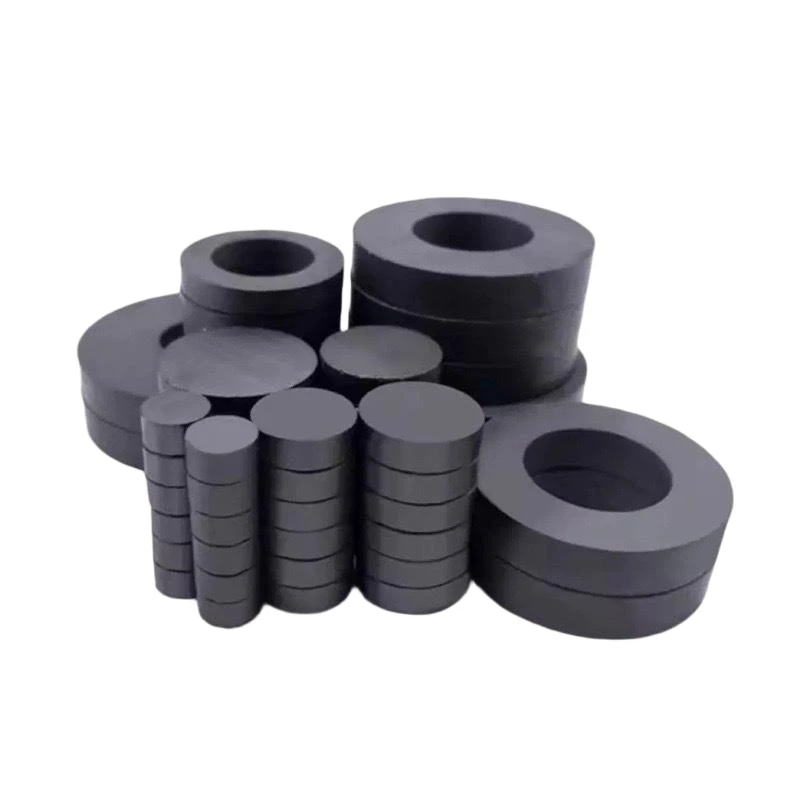
1. What is a Ferrite magnet?
Ferrite magnet, also known as ceramic magnet, is a hard magnetic material made of iron oxide and other metal oxides by high-temperature sintering. It belongs to non-metallic magnets and is divided into soft ferrite and hard ferrite. The former is mostly used in high-frequency transformers and inductors, while the latter is our common permanent magnet products.
Hard ferrite has the characteristics of high coercivity and high magnetic energy product, and is an ideal material for manufacturing permanent magnet motors, speakers, magnetic separators and other equipment.
2. Manufacturing process of Ferrite magnets
The manufacturing of Ferrite magnets is a highly specialized process that requires strict control of process parameters. It is mainly divided into the following stages:
1. Material preparation
The raw materials are mainly iron oxide and strontium oxide or barium oxide. These raw materials need to be proportioned in a strict ratio, and appropriate additives are added to improve the subsequent sintering performance. All raw materials need to be weighed and preliminarily mixed with high precision.
2. Pre-sintering
After the raw materials are mixed, they need to be pre-sintered. Generally, they are heated at a temperature of about 1000°C for several hours to make some of them react and form a preliminary ferrite crystal structure. The main purpose of this step is to stabilize the chemical composition of the material and lay the foundation for subsequent crushing and molding.
3. Fine grinding and classification
The coarse particles after pre-sintering need to be ball-milled to grind them into ultrafine powders with an average particle size of less than 1 micron. At the same time, large particles are removed by screening or grading equipment to ensure the uniformity of the powder.
4. Adding binder and molding
Adding binder to the ground ferrite powder to improve plasticity. After that, pressing and molding are carried out, which can be divided into dry pressing and wet pressing:
Dry pressing is suitable for magnets with smaller size and high precision requirements.
Wet pressing is suitable for special-shaped or large magnets, and demolding and drying are required after molding.
During the pressing process, a magnetic field is often added for orientation treatment to arrange the magnetic grains in a specific direction to obtain anisotropic ferrite magnets with directionality.
5. High-temperature sintering
The formed magnets are sintered at high temperatures in a kiln, generally at 1200°C~1350°C, for several hours. The sintering process will cause the ferrite grains to grow and densify, while completing the establishment of magnetic properties.
6. Processing and grinding
The sintered magnets are usually rough in shape and require mechanical processing to achieve the required dimensional accuracy and appearance. Due to the high hardness and brittleness of ferrite, diamond tools must be used for cold processing.
7. Magnetization treatment
The finished magnets need to be "magnetized" under the action of an external magnetic field to arrange their internal magnetic moments neatly and produce strong magnetism. The magnetization direction can be radial, axial or multi-pole according to the actual use.
8. Performance testing and packaging
Finally, the magnets need to undergo multiple tests such as magnetic properties, dimensional tolerances, and appearance quality to ensure that they meet the standards before packaging and shipment.

3. Key technologies in the manufacture of Ferrite magnets
Although the process of Ferrite magnets is mature, there are still several key process parameters that determine their performance:
Particle size control: Powder particle size directly affects sintering density and magnetic properties.
Sintering temperature and atmosphere: The sintering process requires precise control of temperature and oxygen concentration to prevent abnormal grain growth.
Molding pressure and magnetic orientation: Reasonable pressing conditions and magnetic field direction are related to anisotropic magnetic properties.
4. Main application areas
Ferrite magnets are widely used in the following fields due to their good stability and low cost:
Home appliance industry: such as microwave ovens, electric fans, and washing machine motors.
Automotive electronics: used for sensors, solenoid valves, wiper motors, etc.
Consumer electronics: such as speakers, headphones, and wireless charging devices.
Industrial automation: motors, magnetic separation equipment, and instrument components.
Medical equipment: used for instruments such as nuclear magnetic resonance and magnetic massage.
5. Corporate Case: Shanghai Young Magnet Co., Ltd.
In the global magnetic materials industry chain, Shanghai Young Magnet Co., Ltd. has become one of the important players in the field of Ferrite magnets with its professional technical strength, perfect production system and global service capabilities.
Corporate Overview
Shanghai Young Magnet Co., Ltd. was established in 2003 and is headquartered in Shanghai, China's economic core city. It has its own modern factory. The company focuses on the research, development, manufacturing and sales of various types of magnetic materials. Its products include Ferrite magnets, NdFeB magnets, pot magnets, etc., which are widely used in motors, audio, medical, automobiles, instruments, magnetic adsorption and other fields.
Production and R&D Capabilities
The company has industry-leading production equipment and automated testing systems, and has the full-process manufacturing capabilities from raw material powder preparation, magnetic powder molding, sintering treatment, machining, magnetization detection to packaging and shipment, ensuring the stable performance and accurate size of each product shipped.
In addition, Young Magnet has an enterprise technology center, which is composed of a number of senior magnetic material experts and engineers to form a research and development team to continuously promote product performance optimization and process innovation. The company has obtained a number of national patents and has the technical ability to customize special-shaped magnets and multi-pole magnetization solutions for customers, which can meet the customized needs of high-end industries such as aerospace, new energy vehicles, and intelligent manufacturing.
Product advantages
Ferrite magnet products have the following core advantages:
Stable magnetic properties: high coercivity and good anti-demagnetization ability, suitable for long-term use;
High dimensional accuracy: CNC machining and precision grinding are adopted, and the dimensional error is controlled within ±0.05mm;
Excellent cost performance: self-produced raw materials, automated molding and batch production system ensure cost control;
In the field of directional magnets, the company can accurately control the magnetic orientation according to customer needs, improve the magnetic energy product and work efficiency of the product; at the same time, it can provide a variety of shapes and magnetization methods.
Customers and Markets
Over the years, Shanghai Young Magnet Co., Ltd. has established long-term cooperative relations with customers from more than 60 countries including Europe, America, Southeast Asia, the Middle East, and South America. The export proportion of its products accounts for more than 70% of the total sales, especially in the fields of automotive electronics, motor manufacturing, speaker components, industrial transmission, etc., which have been unanimously praised by global customers.
Customer Service and Support
Shanghai Young Magnet Co., Ltd. not only focuses on product quality, but also attaches great importance to customer service experience. The company has a professional foreign trade team and technical support department, which can communicate in English, Spanish, Japanese and other languages to ensure that overseas customers are efficient and barrier-free in all aspects such as selection, testing, sample confirmation, order execution, and after-sales service.
At the same time, Shanghai Young Magnet Co., Ltd. provides flexible OEM/ODM customization services, supports small batch proofing and fast delivery, and helps customers seize the initiative in the fiercely competitive market.
6. Conclusion
Ferrite magnets, as a traditional but still vibrant magnetic material, play an irreplaceable role in the global manufacturing industry. From the selection of raw materials to the complex sintering and magnetization, every link carries the wisdom and experience of technicians. In the future, with the development of new energy and intelligent manufacturing, the application of Ferrite magnets will be more extensive, and its manufacturing process will continue to evolve to meet more diversified market needs. In the exploration of the magnetic world, understanding its manufacturing process is the first step towards innovative applications.